

Bodhi is nine years old, about seventy-four pounds, and he used to take the back steps down to the yard at a trot. Last spring he started taking them one at a time. Then he started pausing at the top, looking down, and deciding whether the yard was worth the trip. If you have an older dog, you know that pause. It is the reason I ended up on the kitchen floor at eleven at night with a bottle of Nordic Naturals Omega-3 soft gels in one hand and no real idea how many to give him.
Here is what nobody tells you when you start. The bottle is not the hard part. The hard part is the number. Fish oil for dogs is dosed on EPA and DHA, not on the size of the capsule, and those two figures live on the back of the label in small print next to a serving size written for a much smaller animal. Get the number wrong in one direction and you are pouring money into the bowl for nothing. Get it wrong in the other direction and you get loose stools on the living room rug at two in the morning. What follows is the process I actually used with our vet, in the order I used it, including the part where I got it wrong first.
The Bottle Is the Easy Part. Here Is the One You Bring to Your Vet.
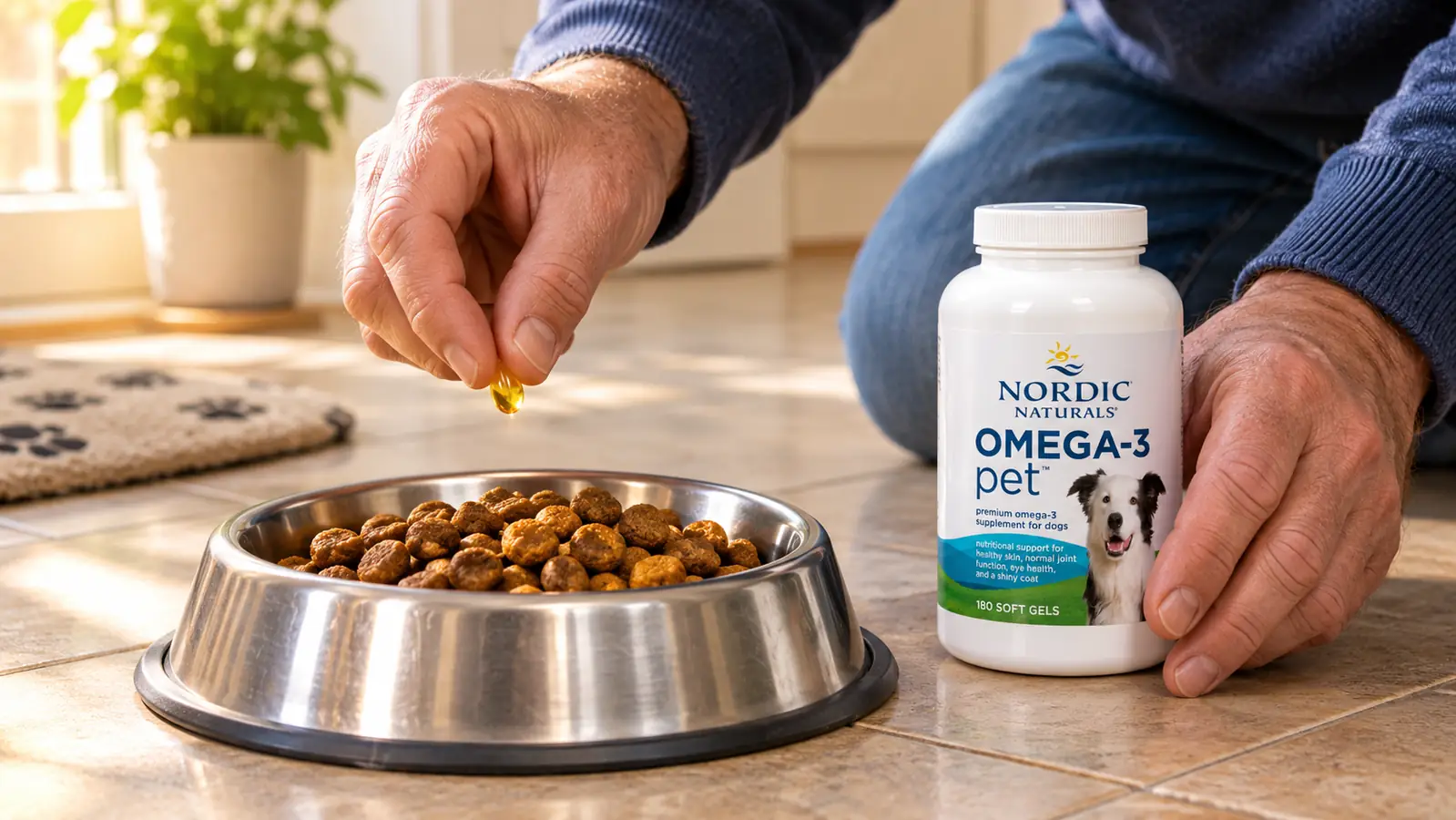
Nordic Naturals Omega-3 Pet comes as 180 unflavored soft gels, with EPA and DHA printed per gel so your vet can set a target you can actually count out at the kitchen counter.
Amazon Check Today's Price on Amazon →Why the Number Matters More Than the Bottle
Two fish oils can sit side by side on a shelf, look identical, and carry wildly different amounts of the thing you are actually paying for. A soft gel is just the delivery vehicle. The EPA and DHA inside it is the dose. So a gel count borrowed from a friend with a different brand, or from a blog post that does not name the concentration, is not a dose at all. It is a guess wearing a number's clothing.
Nordic Naturals prints both figures on the back panel, and the listing notes the oil is in the triglyceride molecular form, the form naturally found in fish. Whether that matters for your particular dog is a good question for your vet and not one I am qualified to answer. What I can tell you is that the back panel is the only part of that bottle that changes anything for your dog. Read it before you read anything else, including this.
Step 1: Weigh the Dog and Write the Number Down
Every calculation after this gets multiplied by your dog's weight, so start there. The bathroom scale method works: weigh yourself, then weigh yourself holding the dog, and subtract. Do it twice, because a wiggling dog adds several pounds of error and you will be surprised how much. The scale at the vet's office is more accurate and costs nothing, which is why I do it there now. Bodhi came in at seventy-four pounds in April, up two from the year before, and our vet wanted that noted as its own separate thing.
Write the number on the bottle with a marker. Not in your phone, not in your head, not on a sticky note that ends up on the floor. On the bottle. You will be standing in the kitchen at six in the morning doing arithmetic before your coffee, and the bottle is the only object guaranteed to be in front of you.
While the marker is out, write the date you started. That sounds like nothing. It is the reason step five works at all, and it is the step almost everybody skips.
Step 2: Ask Your Vet for an EPA and DHA Target
This is where I hand you off to a professional, because I am not a vet and I am not going to pretend to be one on the internet. What I will do is give you the question to ask, because the first time I asked it badly and got a completely useless answer.
"Is fish oil good for him?" gets you a yes and a pat on the arm. "What daily EPA and DHA target do you want for a seventy-four pound nine year old with stiffness in the back end, and is there anything in his bloodwork that makes you want to be careful about it?" gets you a number. Those are two different conversations, and only one of them ends with something written on your bottle.
Tell your vet everything else your dog takes, including any joint supplement, and mention anything on the horizon like surgery or a dental cleaning. There are dogs with a history of pancreatitis where the fat in any oil needs a conversation first, and there are situations where a high amount of fish oil is something to plan around rather than guess at. Our vet asked about all of it before giving me a target. Yours will too, if you give them the opening.
Step 3: Match the Target to the Soft Gels on the Back of the Label
Turn the bottle around. The back panel lists EPA and DHA separately for each soft gel, and you want the two added together, because your vet's target is almost always a combined figure. The front of the bottle with the big numbers is not where this lives, which is how people end up guessing.
Take your target, divide it by the combined EPA and DHA in one gel, and round down to the nearest whole gel. Down, not up. You can add a gel in three weeks without much drama. You cannot un-spend the afternoon your dog had an upset stomach because you rounded in the generous direction.
I am deliberately not printing a gel count here, and I want to be straight with you about why. The number of soft gels that adds up to any given target depends entirely on what is printed on your bottle, and mine is not yours. A count copied off a stranger's blog is exactly how a nine pound terrier ends up on the same amount as a seventy-four pound retriever. Nordic Naturals puts the EPA and DHA on the label so this can be done properly. So do it properly.

Step 4: Start Low, Split It, and Put It in Food
Give half of what you calculated for the first week. If the math gave you four gels, give two. This is not because I think your vet is wrong. It is because some dogs get loose stools from a sudden jump in dietary fat, and you would much rather discover that at two gels than at four. After a week of clean stools, go up to the full amount.
Split the daily total across two meals when you can. Breakfast and dinner, half at each. A smaller amount of oil landing in the stomach at once is easier on most dogs, and spreading the fat across the day is gentler than putting the whole day's worth into one bowl at seven in the morning.
The soft gels are unflavored, which helps a lot, but not every dog will simply eat one off the top of the kibble forever. Bodhi took them whole for about two weeks and then decided he could feel them in there and started eating around them like a tiny lawyer. Now I puncture the gel and squeeze it over his food, and he does not notice it at all. Empty shells left in the bowl are fine to toss. The oil is what you are after.
Step 5: Give It Six Weeks, Then Judge It Honestly
Six weeks, not six days. The first week you will watch so closely that you will see improvement that is not real, and the second week you will decide it is doing nothing at all. Both of those are noise. Same amount every day, for six weeks, then an honest look at it.
What you want to watch is not the big Saturday hike. It is the small stuff around the house. Whether he stands at the top of the stairs before starting down. How long it takes him to get off the floor after lying down. Whether he still hops into the car or stands at the open hatch waiting to be lifted. Bodhi's rear hatch jump is the one I watch, because he does it in the same spot at the same speed every single time and a mid-size SUV does not change shape. Write those things down on the fridge during week one, so you have something to compare against other than your own memory, which is a generous liar.
And if nothing has changed at six weeks, the honest answer might be that fish oil was not the missing piece for your dog. It supports joint and heart health. It does not rebuild a hip or reverse an injury, and no bottle on any shelf fixes a joint that has already gone. What I would do, and what I did, is take the six-week notes back to the vet and ask what the next step is, rather than doubling the oil and hoping harder.
Six weeks in, the thing I could actually point to was not a faster walk. It was that Bodhi stopped standing at the top of the back steps doing math.
What Else Helps
Fish oil is one lever, and on its own it is a small one. The things that moved the needle most for us were boring and free. Weight came first, because two extra pounds on a seventy-four pound dog is two pounds of additional load on the same joints, every step, all day. Then the floors. A two-story house with hard flooring is a skating rink for a dog with a sore back end, and a few cheap runner rugs through the kitchen changed how confidently Bodhi walked through that room. He stopped bracing. Bracing is half the battle.
Shorter walks, more often, beat one long one. A few minutes of easy movement before a trail and a slow last ten minutes at the end. A ramp for the car if the jump has gotten dicey. And if your dog has started to dread the back steps the way mine did, a hind-leg support sling takes the fear out of it for both of you, which matters more than it sounds, because a dog that is nervous about the stairs stops using them, and then loses the strength that kept him using them. Ours hangs by the door.
The joint supplement question is a separate conversation from the fish oil question, and plenty of owners end up researching both in the same week. Nordic Naturals is a general omega-3 product, listed for joint use and heart health, and it is not a substitute for a joint supplement and not a substitute for your vet. They are different tools, and they get decided separately, ideally in the same phone call.
Get the Label in Your Hands Before the Next Vet Visit
One bottle of 180 soft gels covers a six week trial with room to adjust the amount partway through. Bring the back panel, not the front.
Amazon Check Today's Price on Amazon →