
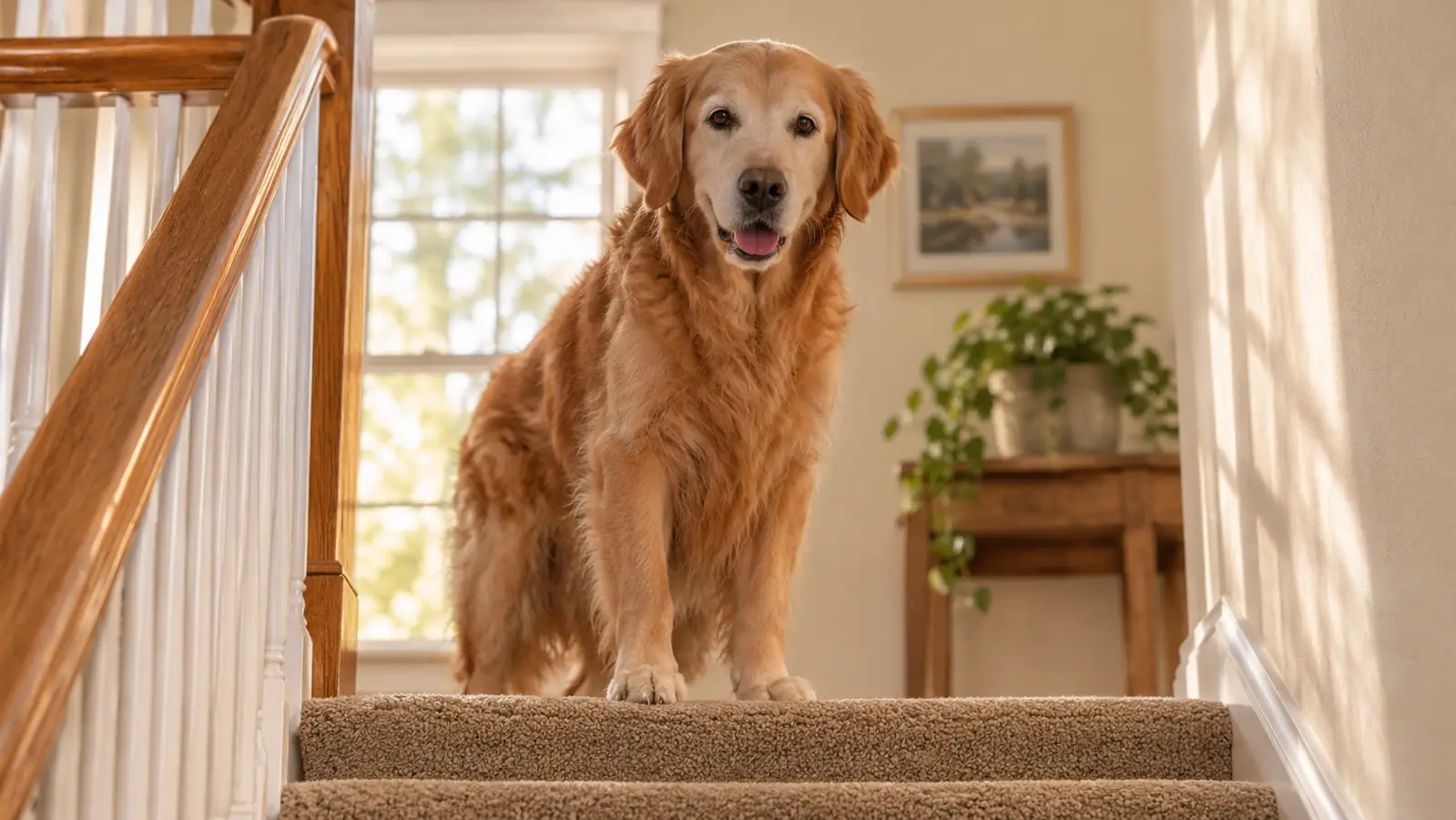
The back steps at our house are six risers of old brick, and for years Bodhi went down them like he owned the place. He is a nine-year-old golden retriever, about 74 pounds, and around his eighth birthday he started stopping at the top and just standing there. Not refusing. Thinking. Then he would take the steps one at a time, back end swinging a little, and act like nothing had happened. If your dog has started doing arithmetic at the top of a staircase, you know the feeling that puts in your stomach.
I am not a vet. I am a real estate agent in Ventura County who walks the beach most mornings and hikes the local trails on weekends, and I have spent the past year figuring out how to keep a big dog moving without pretending he is younger than he is. This is the routine that worked for us. The center of it is a hind-leg support sling, the adjustable one made by PICK FOR LIFE, plus five habits built around it. Call your vet about your own dog first. Then read this.
The sling that turned six brick steps back into six steps
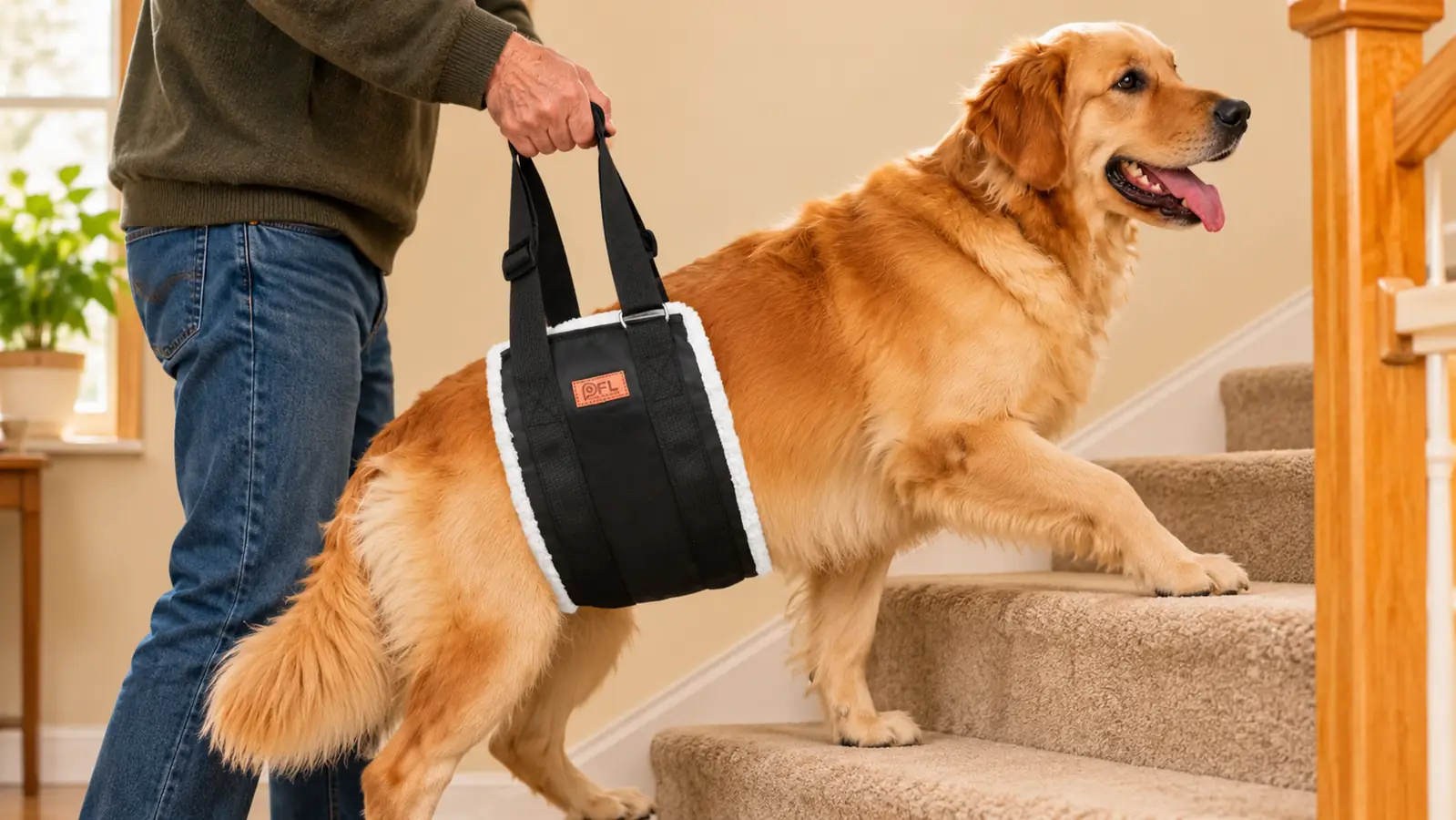
The PICK FOR LIFE adjustable sling for large dogs supports the hind end with padded handles and weighs 8.8 ounces, so it hangs by the back door instead of living in a closet. It is the one piece of this routine Bodhi cannot do without.
Amazon Check Today's Price on Amazon →Step 1: Get Your Vet's Read Before You Order Anything
The first thing I did was wrong. I bought a sling the same week Bodhi hesitated on the steps and started using it before anyone had looked at him. Our vet was patient about it, but she made the point that a sling is a support tool, not a diagnosis. A dog who is stiff after a long hike and a dog with a torn cruciate can look similar from three feet away, and those two dogs need completely different plans.
She asked which leg he favored, whether the stiffness was worse after rest or after exercise, and whether he had ever yelped. She moved his hips and knees, watched him trot down the hallway, and then gave me the honest version. Mild wear in both hips, no crisis, keep him moving, keep him lean, and use support on the stairs so a bad slip does not turn a manageable problem into a surgical one. The appointment took about forty minutes. The part I remember is her hand on his hip, feeling for the pop, and asking whether he had ever bunny-hopped up the back steps. He had, most days for a month, and I had assumed it was enthusiasm.
Three questions are worth asking your own vet before you spend anything. Should the sling sit under the belly or further back toward the hips? How much weight should I actually be carrying, since most of us take too much? And what would tell me to stop and call back, because a dog who gets worse with support needs a different conversation than a dog who gets better. Write the answers on your phone. You will not remember them at the bottom of a staircase, and that note is the only reason I still know what she said about the belly position.
Step 2: Fit the Sling Before You Go Near a Staircase
The PICK FOR LIFE sling is nylon, machine washable, and 8.8 ounces, which matters more than it sounds. It arrives with a handle, a storage bag, and a short user guide, and it is the size Large, meant for big dogs. The closure is a drawstring, so there is one adjustment to make and, once you make it, almost no reason to touch it again.
Fit it on flat ground with the dog standing square, not sitting. The sling goes under the rear belly, just in front of the hind legs, with the handles coming up on either side. Snug enough that it does not slide when you lift, loose enough that you can slide two fingers under the webbing while it hangs slack. My first attempt happened in the driveway on a Saturday morning with the engine still warm, which was a mistake, because Bodhi was excited and would not stand square for anything. Do it inside, on a floor that does not slide, after a walk when the dog is warm and settled.
Then check for rubbing before you ever put weight on it. I walked Bodhi up and down the hallway twice with the sling on and no lift at all, and the first fit left a red line behind his front leg by the second pass. One adjustment of the drawstring fixed it, and I put a small piece of tape on the webbing to mark the spot so I could find it again after a wash. The rule I use now is simple. A sling that rubs is a sling the dog will fight, and a dog who fights the sling loses the whole benefit of it.
Step 3: Practice on Flat Ground Until It Is Boring
Stairs are the exam and the hallway is the classroom. The first three sessions with Bodhi were ninety seconds each, in the kitchen, with the sling on and no lift at all. I fed him a piece of chicken, ran my hand along his back, took the sling off. That was the entire session. Older dogs are conservative, and a new strap around the back end reads as something to be suspicious of.
Session four, I took a little weight. Not a lift, just enough that the handles went taut while he stood. Then a few steps forward with me walking beside him, my hand steady, the sling doing maybe ten percent of the work. By the end of that week I could raise his hind end a couple of inches and he would step forward instead of bracing against me. I counted nine sessions over eleven days before we went anywhere near the brick.
If your dog panics, go backward. Bodhi sat down hard the first time I lifted, and I spent two days undoing it with nothing but the sling draped over his back and treats on the floor. I did not lift again until he was walking toward the sling on his own instead of away from it. Boring is the goal. A dog who has practiced with the sling on flat ground is a dog who will not fight you on the fourth stair.
The sling does not carry your dog up the stairs. It takes the load off the hip that is doing all the work, which is the difference between a dog who climbs and a dog who quits.
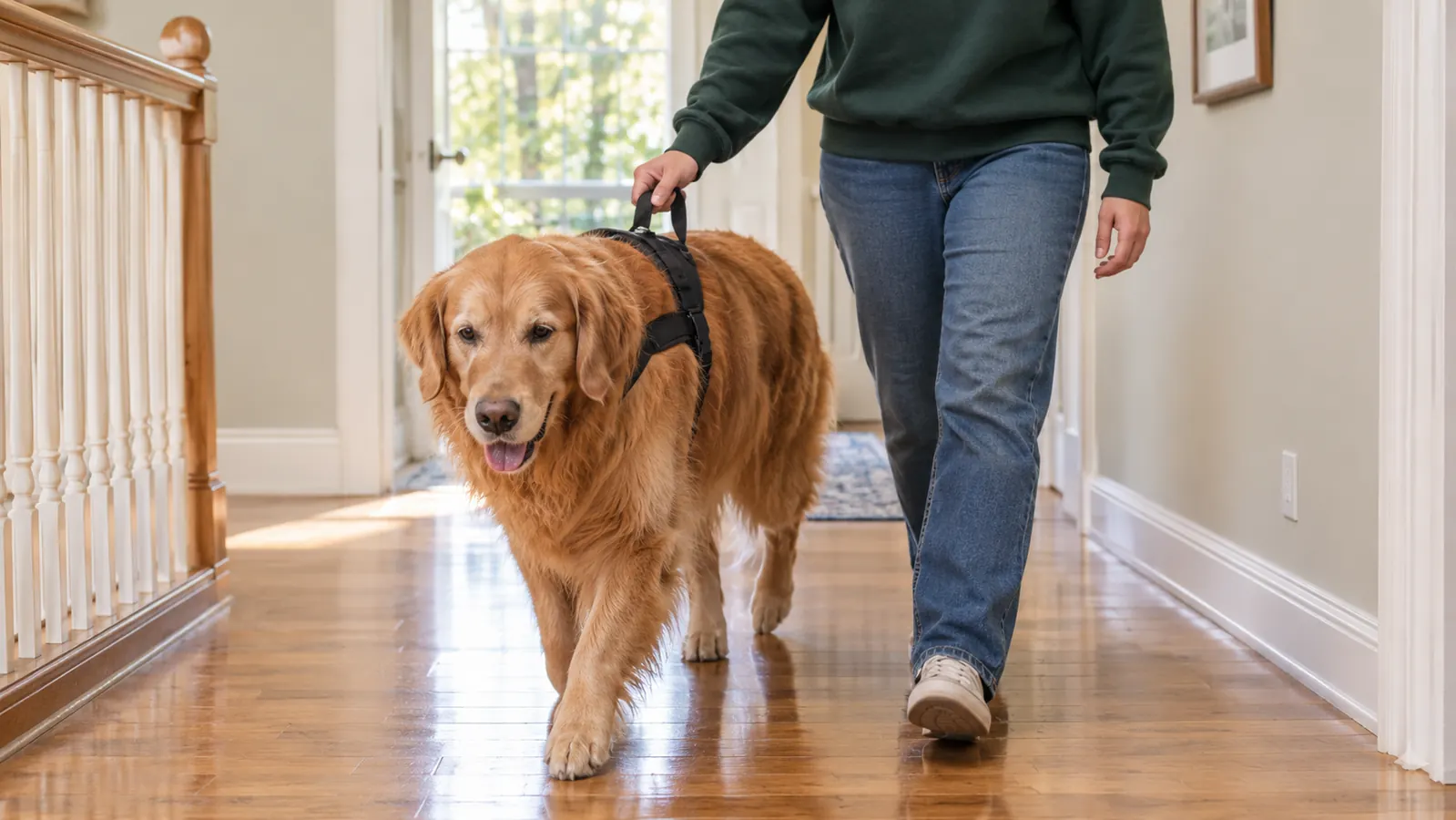
Step 4: Take the Stairs One Step at a Time
Going up, I stand behind and slightly to one side, handles in one hand and leash in the other, and I let Bodhi set the pace. The sling stays slack until he pushes off, then I take weight for the two seconds his back leg is working. Then slack again. If I hold tension the whole way up, he leans into it and stops using the leg, which is the opposite of what we want.
Going down is the harder direction and the one most people rush. I go first, one step below and off to the side, with the sling taut enough to catch him if the back end gives. Six risers takes us about thirty seconds now. It took a full minute the first month. Counting the steps out loud helps you stay slow, because the urge to get it over with is exactly what causes a slip. Our first real attempt was a Sunday morning in October, cool enough that he was not panting at the top, and I let him rest on the fifth riser for as long as he wanted. He finished the last two on his own.
One stair at a time, a rest at the landing, and no stairs at all on a day he is already stiff from a long walk. That last rule came from our vet and it is the one I break least. The PICK FOR LIFE sling is what makes the climb possible. The rest day is what makes it work again next week.
Step 5: Build the Rest of the Day Around the Climb
The stairs are a small part of a day. What changed Bodhi most was everything around them. Shorter walks, more of them. Two twenty-minute loops instead of one forty-minute push. A warm-up before we leave the driveway, which for us is a slow lap of the front yard on the leash with no sniffing, just movement.
I keep a note on my phone. One line a day: how many stairs, how he looked at the top, whether he was stiff that night. It sounds like bookkeeping and it is, but after six weeks the pattern was obvious. The days after a long beach walk were the days he hesitated. That is not something I would have remembered on my own, and it changed how I plan our weekends.
I also stopped pretending the back steps were the only place it mattered. The car is a step for him too. He used to launch himself into the SUV through the rear hatch, and now he waits for the sling and a hand. It takes me ninety extra seconds. It has bought me another year of him still coming along.
What Else Helps
Weight is the first thing. Bodhi is 74 pounds at nine. Our vet's point was blunt. Every extra pound is a pound the hips do not need to carry up a staircase. We cut his food by a quarter cup and swapped one of his biscuits for a green bean, and he did not notice either change. That is the simplest mobility tool there is, and it takes less effort than everything else in this article put together.
The second is oil. Bodhi gets Nordic Naturals Omega-3, a general fish oil that many owners use alongside a joint supplement for EPA and DHA support. It is not a treatment and I would not describe it as one. Our vet framed it as part of a base, something that supports the system while the sling and the shorter walks do the visible work. Ask your vet whether it fits your dog, especially if your dog takes anything else.
The smaller stuff adds up too. Nails trimmed so the toes land flat. A rug at the bottom of the stairs instead of bare hardwood. A night light for the two-in-the-morning water trip. And a standing item on the calendar every six months, because a dog who is slowly changing is hard to see from inside the same house every single day.
One more thing, and it is the least popular one. Some days the honest answer is no stairs at all, and that is not a failure of the gear. If your dog is guarding a leg, panting at the top of the flight, or getting worse over two weeks instead of better, that is a call to your vet, not a reason to lift harder.
Six steps. One sling. One dog who still comes with me.
If your dog has started doing arithmetic at the top of the stairs, this is the simplest version of the fix I found. Fit it on flat ground, practice until it is boring, and take the stairs slowly with your vet's plan in hand.
Amazon Check Today's Price on Amazon →