

Bodhi is nine, seventy four pounds, and for most of his life he was the one pulling me up the trail instead of the other way around. Then he started lagging on the last half mile of our Saturday loop. Nothing dramatic about it. He walked closer to my knee, took the back stairs one at a time instead of two, and stopped launching himself into the hatch of the SUV. I am not a veterinarian. I sell houses in Ventura County, I hike on weekends, and I wanted my dog to keep coming with me.
Here is what I got wrong first. I bought a tub of hope, gave it for four days, saw nothing, and quit. Then I tried a powder I had to mix into his food, which he carefully ate around. Then a chew so hard he crunched it once and left it on the rug. What finally stuck was boring: Zesty Paws Mussel Mobility Bites, a chicken and mussel soft chew he actually eats, a routine I could keep for months, and a vet who told me what to realistically expect. That is the order of operations I wish someone had handed me at the start, and it is what follows below.
The chew that survived a picky dog's nose
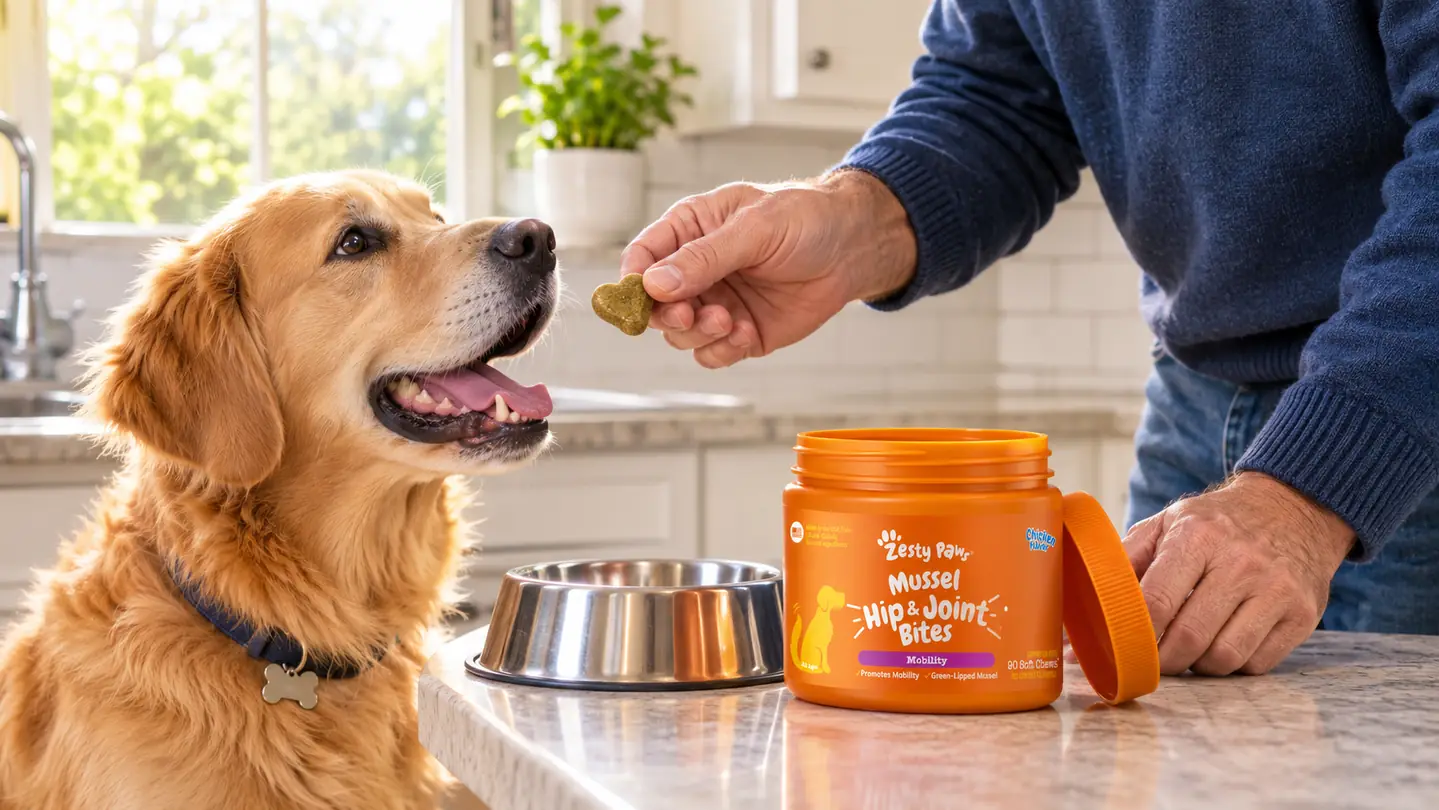
Bodhi turns his nose up at most supplements. These soft chews he takes like a treat, which is the only reason our routine made it past week two. The feeding guide and current price are on the listing.
Amazon Check Today's Price on Amazon →Step 1: Write down a baseline before you change anything
Before I bought a single thing, I should have measured something. Pick four daily moments and score them the same way every time. For us that was: how Bodhi gets off his bed in the morning, how he handles the back stairs, whether he lags on the second half of the walk, and whether he still wants to jump into the car. Give each one a simple 1 to 5, where 1 means he did it easily and 5 means he hesitated or needed help.
Then take a thirty second video of the stairs on your phone. This sounds fussy and it is the single most useful thing I did, because memory is a terrible record. Six weeks in, I was sure nothing had changed until I watched the first video next to a new one. He had gone from three separate motions at the bottom step to one. I would have argued with anyone who told me that, right up until I saw it side by side.
Write the scores down somewhere you will actually look at them, not in your head. I used the notes app on my phone with a date at the top of each entry, and I filled it in at the same time every morning, before his breakfast, while he was still deciding whether to get up. That timing turned out to matter. Early morning is when a stiff dog is at his stiffest, so the morning score is the one that showed change first. An evening score would have been averaged with a dog who had been moving all day and looked better than he really was. Keep the route boring too. Same sidewalk, same three houses to the corner, same leash, so that the only variable is the dog.
Step 2: Get your vet's eyes on it before you buy anything
Stiffness in an older dog has more than one cause, and not all of them are joint related. Nails that need trimming, sore paw pads, a bit of extra weight, an old soft tissue strain, something going on in the spine. I brought the stair video to our vet and asked one direct question: is this a joint support conversation, or is it something else first? That question saved me from spending three months supplementing a problem that needed a different answer.
While you are there, bring the label or the product page. Ask whether anything in it interacts with what your dog already takes, and ask what amount suits your dog's weight. Our vet was also the one who told me to change one thing at a time, so if something helps, I would actually know which thing it was.
The appointment itself was shorter than the drive. Our vet had me walk Bodhi down a hallway and back, then watched from the side while he stood still and shifted his weight. She ran her hands along his spine and both back legs, picked up each paw, and turned them over to look at the pads. She asked me when he was last on the scale and then weighed him at seventy four pounds, which was four pounds more than the last visit two years earlier, and she said so out loud. That number changed my thinking more than anything else that morning. Four pounds on a nine-year-old with a stiff back end is not a cosmetic issue, it is a load he carries up eleven back steps several times a day. We left with a plan that started with cutting back his portions by about a quarter cup a day and adding a few short walks, before we talked about anything in a tub.
Step 3: Start the chew slowly and keep the rest of the routine still
What I like about the Zesty Paws bites is mostly unglamorous. They are a soft chew, chicken and mussel flavored, and Bodhi takes one straight from my hand without a negotiation. The formula is built around cold processed New Zealand green lipped mussel with natural glucosamine, and it is a limited ingredient chew, which mattered to me after the powder disaster. The active ingredient panel lists chamomile. The tub is small, under four inches on a side, and it lives on the counter next to his bowl now.
I followed the feeding guide on the package and confirmed the amount for a seventy four pound dog with our vet. Then I gave it at the same time every morning, right after his breakfast, and did not change anything else for two weeks. That last part is the hard part. Two weeks feels like forever when you are watching for a result, and it is the minimum amount of time that means anything.
One honest note. A chew is support, not a repair. Nothing here treats or reverses arthritis, and if a product promises that, walk away. What I was buying was a daily habit that gives an older dog consistent nutritional support for hips and joints while I did the other work below.
Step 4: Fix the floors, the stairs, and the car before you blame the supplement
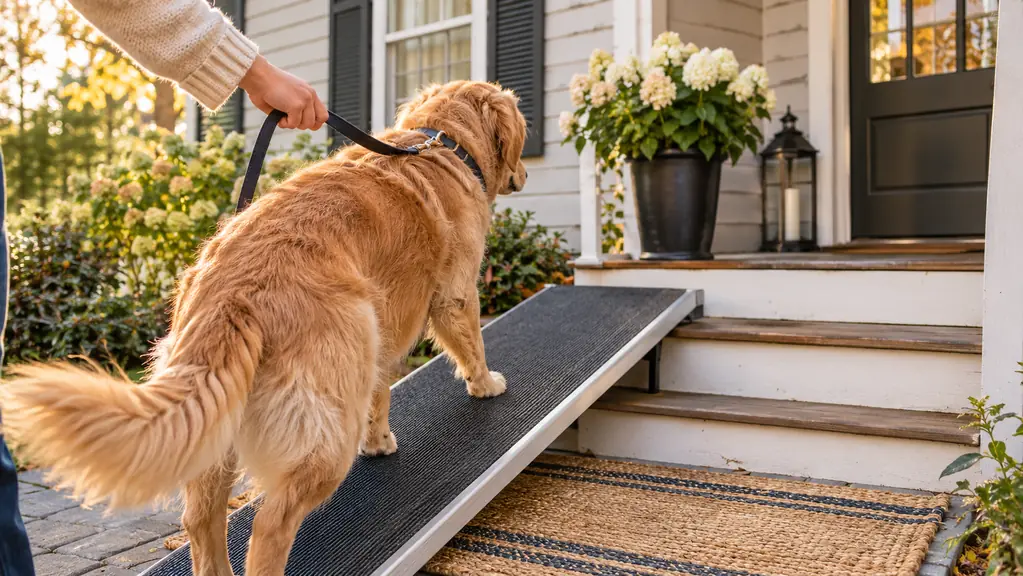
This is the step nobody sells you, and it may be the one that mattered most. Our house has hardwood, and a senior dog on hardwood is a dog doing a small split on every turn. I put a runner down the hallway and a rug at the bottom of the back stairs. I trimmed his nails on schedule. I bought a low ramp for the SUV hatch so he walks up instead of jumping, which he took to in about a day and a half.
The runner was not a small purchase. Our hallway is about eighteen feet from the front room to the kitchen door and I measured it twice before ordering because I did not want to be sending something back. I went with a ten foot runner and a separate four foot mat at the kitchen end, which left a small gap I filled with a cheap doormat. Sounds ridiculous written down. What it means in practice is that Bodhi can get from his bed to his water bowl without a single slip, and I did not realize how often he was bracing until he stopped.
I also changed the walks. Shorter and more often, with the first five minutes slow on purpose so he warms up before we ask anything of him. Sniff breaks are not wasted time for a dog with a stiff back end, they are a natural pause. And I stopped doing the long Saturday loop every single weekend. We do it every other week now, and he finishes it instead of limping through the last mile.
Step 5: Recheck at 30, 60, and 90 days with the same scorecard
Pull out the video and the four scores at thirty days, sixty days, and ninety days. Use the same route, the same time of day, the same camera angle. This is where I have to be straight with you, because the internet is full of before and after stories that are not real. Bodhi did not turn into a puppy. The honest summary is that his scores moved slowly, one point here and there, and the direction was better than it was before. Some of that is the chew, some of it is the rugs and the ramp and the shorter walks, and I cannot tease those apart.
Here is what the thirty day mark actually looked like, since vague timelines are useless. Day one, the stairs score was a four. Day thirty, still a four. Day sixty, a three. Day ninety, a two, and that is the entry I stared at for a while. The car score went from five to three over the same stretch, mostly because the ramp removed the jump entirely, and I am not going to pretend the chew did that. The morning stiffness score moved the least, from four to three, and it is still the first thing I check every day because it tells me the most.
Decide in advance what would make you stop. For me it was this: if the scores were flat or worse at ninety days, or if his stomach got upset, or if our vet wanted to change course, I would stop and not talk myself into another tub. That is a much better way to run this than quitting after four days because nothing dramatic happened.
Six weeks in, the only number that changed was one. Bodhi went up the back stairs in a single motion instead of three, and I only knew because I had filmed the first day.
What Else Helps
A few things I would do again without hesitating. Keep his weight where the vet wants it, since every extra pound is a pound his hips carry up the stairs. Warm water swimming or a slow wade at the beach on a warm morning, because Bodhi will happily paddle for ten minutes and it is the gentlest exercise we have found. A firm bed instead of the thin mat he had, especially on cold mornings. And a general fish oil for EPA and DHA is something a lot of owners use alongside a joint chew, our vet included in that group, though I treat it as background support and not as a joint treatment.
What did not help us: a very hard chew he could not comfortably work on, a powder he could taste, and my own habit of adding three new things in the same week so that nothing could be measured. One change at a time is slower and it is the only way I have found to know what is actually doing something.
When to Stop and Call Your Vet
Call sooner rather than later if you see a sudden change instead of a gradual one, if your dog is dragging a back leg, if there is swelling, if he stops eating, or if he snaps when you touch his hips. Those are not supplement questions. Also call if the stiffness is getting worse despite everything above, because there are prescription options and physical therapy options that a chew cannot replace, and an older dog does not have months to spend on trial and error.
Film the stairs today, start the chews this week
One thirty second video, one call to your vet, and one daily habit you can actually keep. Zesty Paws Mussel Mobility Bites is the soft chew that stayed in our kitchen. Confirm the amount for your dog's weight with your vet first.
Amazon See the Mussel Mobility Bites on Amazon →